

For a business, glass is part of the brand. Shopfronts, reception areas, office glazing and school entrances are judged in seconds by customers, staff and visitors, and dirty glazing says something about the organisation behind it. This guide sets out how professional commercial window cleaning works, how a schedule is planned, how work at height is handled, and what to expect from a contract.
Glazing is part of how your premises are judged
Customers form an impression of a business before they step inside. A clean, bright frontage suggests care and professionalism, and smeared, spotted or green-tinged glass suggests the opposite. For retailers, a clear shopfront also helps displays do their job, and for offices, clean glazing lets daylight in and gives staff and visitors a better view.
Glazing is also one of the most visible parts of a building to keep up to standard. A reliable cleaning schedule means it is done without anyone having to think about it.
What we clean
The scope is agreed with you for each site, and usually includes the following:
- External glazing, including shopfronts, curtain walling, windows and door glass
- Frames, sills and ledges, cleaned along with the glass so the whole unit looks consistent
- Entrance doors and side panels, which collect the most fingerprints and splashes
- Canopies, porches and low-level glazing within reach of a pole
- Any additional areas agreed with you in advance, such as signage faces or adjacent glazing
Entrances, doors and high-contact glass
The glass that visitors actually touch deserves particular attention. Entrance doors, push plates, side panels and low-level glazing collect fingerprints, rain splashes and the grit thrown up by passing traffic, and they sit at eye level for everyone who walks in. These areas often justify a more frequent visit than the upper floors, even where the rest of the building is on a longer cycle.
Frames, thresholds and sills matter as much as the glass. A spotless pane in a grey, dusty frame still reads as neglected, so we clean the whole unit to a consistent standard, including the ledges and door edges where dirt and cobwebs tend to gather.
Methods matched to the building
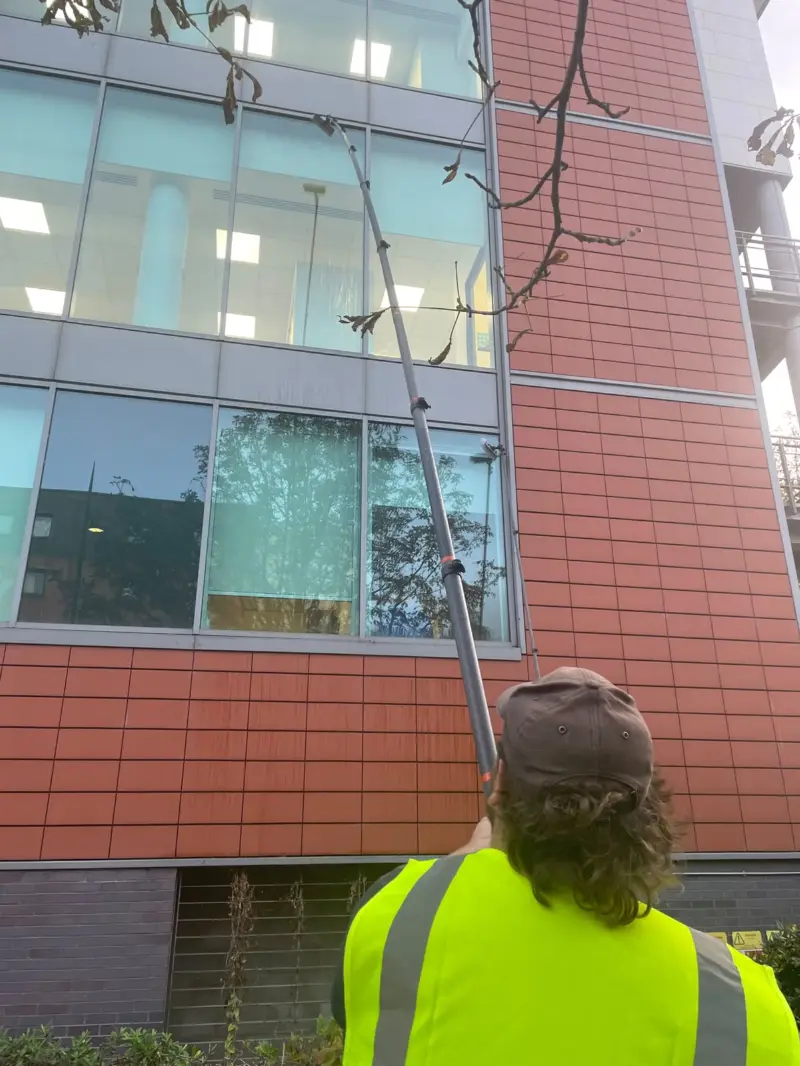
We choose the method according to access, height and glazing type. Water-fed pole systems with purified water clean glass, frames and sills to a spot-free finish without chemical residue. They allow much of the work to be done from ground level, which keeps equipment and operatives out of the way of staff, customers and pedestrians.
Where the building calls for it, we use traditional squeegee and ladder techniques, for example on detailed shopfronts, small panes and areas a pole cannot reach. The aim is always the right tool for the specific glazing, not a single method applied everywhere.
Work at height and safety
Falls from height are a leading cause of serious workplace injuries, and regulations expect work at height to be avoided where possible. A water-fed pole system helps with that, because it lets much glazing be cleaned from the ground without ladders or platforms.
Where access arrangements do involve working at height, the method, the equipment and the safety measures are agreed with you in advance so that the work is planned and not improvised. We are fully insured, and you are welcome to ask about the cover for your site when you enquire.
The site review: scoping the glazing before the first visit
Every contract starts with understanding the building. A site review records the amount and type of glazing, which elevations are street-facing or exposed, how each area is reached and what restricts access, such as pedestrian routes, parking, locked yards, canopies and planters. We note where a pole will do the work and where squeegee and ladder techniques are better suited, and we flag any glazing that needs a closer look before it is cleaned in the usual way.
The result is a scope that both sides can read: which areas are included, how often, at what time of day and by what method. Because everything is agreed at the start, the visits that follow are routine, and a change to the scope is a conversation rather than a surprise.
Planning a schedule that suits your premises
Commercial cleaning works best on a fixed, predictable schedule agreed in advance. We start with a site review, looking at access, the amount and type of glazing, any restrictions and the standard you want. From that we recommend a frequency and agree visit times with you.
The right frequency depends on the premises. Street-facing retail frontages and entrances pick up dirt quickly and often suit more frequent visits, such as every two to four weeks. Upper-floor office glazing is often fine on a longer cycle, such as every six to eight weeks, or quarterly. Where buildings are near building sites, busy roads or trees, shorter cycles keep standards up.
Minimising disruption to staff and customers
A cleaning visit should not get in the way of the business. Timings are agreed around your operating hours, so shopfronts can be cleaned before opening or at quiet times, and offices and public buildings at times that suit staff.
Working from the ground with a pole keeps equipment compact and minimises time on site. Pedestrian management, signage around wet pavements and any access arrangements for doors and entrances are discussed in advance, so cleaning is predictable, safe and unobtrusive.
Shops, offices, schools and public buildings
Different premises have different needs. Retail units need frontages kept welcoming and displays clear, often with early or quiet-hours visits. Offices and business parks need consistent, regular upkeep of larger areas of glazing. Schools, care homes and public buildings need carefully planned visits that respect pupils, residents and visitors, with access and timings agreed in advance.
Whatever the sector, we agree the details with you before the first visit, so there are no surprises about what is included, when we arrive and how we leave the site.
What to expect from the service
A good commercial window cleaning service should be dependable and easy to deal with. You can expect the following:
- A clear scope of work, agreed before the first visit
- A recommended frequency and visit times that suit your premises
- Visits carried out as agreed, with minimal disruption
- A spot-free finish across glass, frames and sills
- A straightforward way to change a visit if your plans change
- Regular reviews, so the schedule keeps pace with how your premises are used
Managing several sites or units
Property managers, retail groups and organisations with more than one building usually want consistency above everything: the same standard at every site, on a rota that does not have to be chased. We can plan visits across several premises in one schedule, with a clear scope for each site and a single point of contact for changes.
Where units share a frontage, a parade or a business park, cleaning them in one visit is usually more efficient than separate calls, and it keeps the whole frontage looking even. Tell us about all the units when you enquire, and we will suggest how to group them.
Questions to ask any commercial window cleaner
Whoever you choose, a few questions separate a reliable contractor from a casual one:
- Are they fully insured, and will they talk you through the cover when asked?
- Which methods will be used on your glazing, and why?
- How will work at height be handled, and can it be avoided?
- When will they visit, and what happens if the weather or your plans change?
- Who will you speak to, and how quickly will they respond?
- What exactly is included: glass, frames, sills, doors and canopies?
Still reading? There is more.
10 more sections cover:
- Methods matched to the building
- Work at height and safety
- The site review: scoping the glazing before the first visit
- Planning a schedule that suits your premises
- Minimising disruption to staff and customers
- Shops, offices, schools and public buildings
- What to expect from the service
- Managing several sites or units
- Questions to ask any commercial window cleaner
- Related services for business premises