

A shopfront is a sales tool, and an office entrance is a statement of intent, but both are exposed to a relentless build-up of traffic film, weather and dust. The premises we look after around Rotherham make a one-size-fits-all approach impossible: a restaurant frontage on Wickersley's main road has little in common with a unit beside the M1 at Thorpe Hesley, and both differ from a community building in South Anston. This guide sets out how we run commercial window cleaning contracts in the eight places we cover, what each one asks, and how a schedule is built.
Commercial glazing around Rotherham: the setting
Motorway corridors shape much of the area. The M1 runs past Thorpe Hesley and Brinsworth, the M18 joins it near Wickersley, and Bawtry Road and the A57 carry a continuous stream of vehicles past retail frontages. The exhaust and road film they leave is the dominant soiling on street-level glass.
Beyond the main roads, the exposure differs. Frontages in North and South Anston stand on open ground, where wind and the fine pale dust of the nearby quarries mark glass quickly. Premises in Greasbrough and Scholes tend to be older and smaller, set among trees and gardens beside the Wentworth estate, and those on the Kimberworth ridge face the weather head on. We assess each site for these conditions, and set the frequency, method and timing to suit.
Premises we clean: shops, offices, schools and community buildings
Retail and hospitality are the largest group: shopfronts on local parades, restaurants and bars, and village shops. Offices and business units range from first-floor suites above retail to purpose-built premises on commercial land. Schools, churches, clubs, surgeries and community buildings bring older glazing, specific visitor patterns and security considerations that need to be agreed in advance.
The specification follows the building. Large plate-glass fronts and regular upper windows are work for the pole and its purified-water rinse. Small panes, bars and period glazing may call for a squeegee and ladder. The scope, the visit times and the method are settled with you in writing before the first visit, so that the contract is clear from the start.
Village premises in Thorpe Hesley and Scholes
Thorpe Hesley's shops, pubs and community buildings sit near its church and along the main road through the village, close to junction 35 of the M1. Frontages on the motorway side carry a heavier traffic film than most village premises, and entrances on the hill can be set at an angle to the pavement. We plan each position for stable footing and keep doorways clear.
Scholes is a small village on the edge of the Wentworth estate with only a handful of non-residential buildings, and they are served on the same route as Thorpe Hesley. Older stone premises there often have small panes and timber frames that suit hand work, and the trees around them add sap and leaf litter to the normal road film.
Shops, schools and clubs in Kimberworth and Greasbrough
Kimberworth has shops along its main roads and around Kimberworth Park, a large secondary school and a range of churches and community buildings. Premises on the ridge face open weather from the valley, so frontages streak quickly in wind-driven rain, and steep approaches mean uneven pavements at some entrances.
Greasbrough is local and community in character, with its working men's club, chapels, church, shops and schools close together in the old village centre, beside the parkland of Wentworth Woodhouse. Overhanging trees add sap and leaf litter to glazing, and older buildings bring detailed windows that are done by hand. Parking and pedestrian management are agreed in advance, so the visit is quiet and tidy.
Parades, restaurants and schools in Brinsworth and Wickersley
Brinsworth's parades, surgeries and schools serve its large estates, and the motorway and the main roads nearby keep a steady film on street-facing glass. Single-storey parades with regular plate-glass fronts suit the pole system well, and visits can be timed before the shops open.
Wickersley has the busiest village centre we cover around Rotherham, with bars, restaurants, cafes and independent shops near the old church of St Alban's and along Bawtry Road, as well as one of the largest secondary schools in the borough. Hospitality frontages are seen up close by diners and need a consistent finish, often on a short cycle, with visits slotted in before service begins.
Village centres in North Anston and South Anston
Anston has premises on both sides of its brook, with the A57 and a freight railway running between North and South. Local shops, pubs, schools and community buildings sit among the modern estates of North Anston and the older limestone buildings of South Anston, including its church and chapels.
The pale dust from the quarries around South Anston is a distinctive soiling agent, clinging to damp glass in a haze that rain does not remove, and the open ground lets the wind carry it a long way. A regular cycle keeps frontages clear, and older limestone premises with small panes are cleaned by hand where that gives the better result.
How a Rotherham contract begins
Before any price or timetable, there is a survey, either on site or from your photographs and plans. It answers a short list of practical questions, and the answers shape everything that follows:
- How much glass there is, on which elevations and at what height
- What the frames are made of and how they are fixed
- How the glazing is reached: pavement, forecourt, yard, canopy or steps
- What limits access, such as bus stops, narrow footways, loading times or locked gates
- Who uses the entrances, and when they are busiest
Methods matched to the glazing
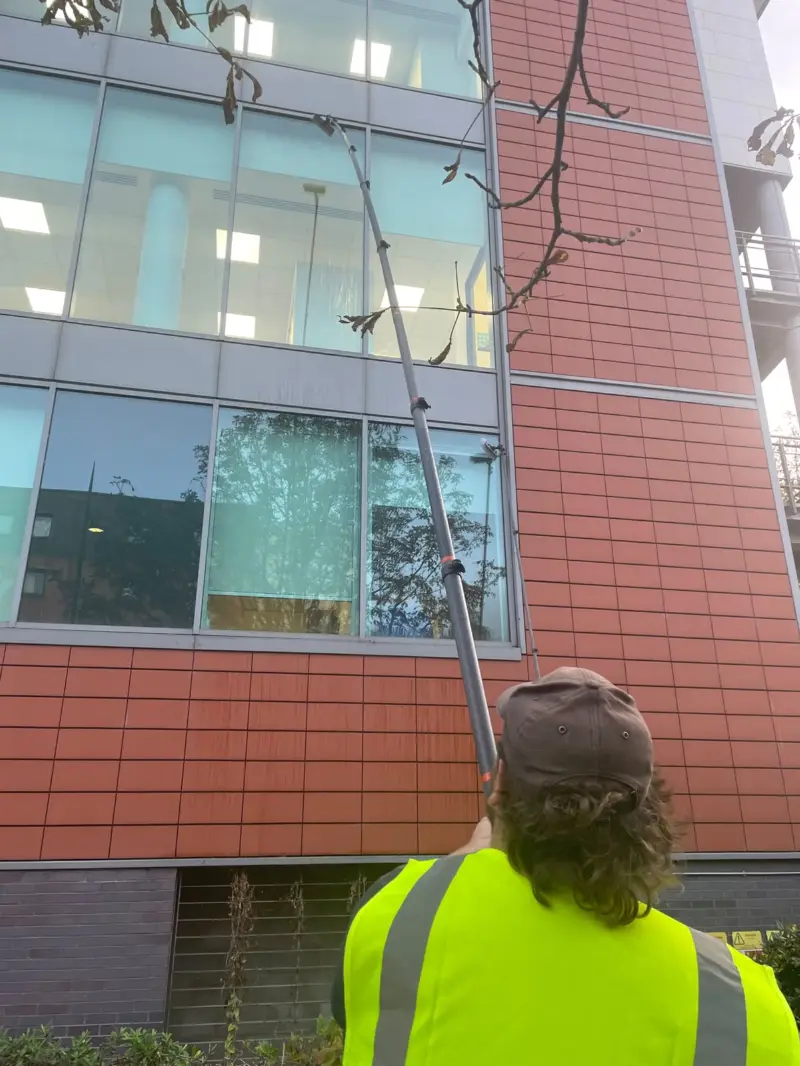
Pure-water pole systems do most of the work: shopfronts, regular office windows, frames and sills at reachable heights. The glass dries without spots or a film of detergent, and the operator stays on the pavement.
For small panes, glazing bars and the leaded or multi-paned windows found on older civic and village buildings, a traditional squeegee and ladder gives a better result. Choosing between the two is a decision for each element of a building, not a house style.
Frequency and timing
There is no universal interval. Fortnightly to monthly visits are common for shopfronts and restaurants on busy routes, where road film returns quickly. Offices with glazing above street level are comfortable on a cycle of six weeks to a quarter. Premises near roadworks, junctions or overhanging trees tend to need a tighter rhythm in spring and autumn. The survey gives us a starting point, and the building itself tells us whether to move it.
The visit fits around your day. A shop can have its frontage done before the doors open, a restaurant before service, an office in a quiet slot, and a school or club at times that keep users clear of wet ground. Equipment is compact, doorways are never blocked for long, and the whole thing is usually over before most people notice it has started.
Weather, seasons and holding a standard
Glazing shows different faults at different times of year. Low winter sun exposes every streak and smear, spring pollen and blossom settle on frontages, and summer dust drifts in from open land and quarries. Autumn brings leaf fall and wet pavements, which splash glass at low level more than at any other time.
A fixed schedule smooths all of that out. Instead of a frontage swinging between spotless and tired, it holds a steady standard, and the interval can be tightened in the months when the weather is hardest on it. Gales and ice are the only things that stop a visit, and when they do, we rebook promptly.
Entrances, thresholds and the surrounds of the glass
What people touch tells them most about a business. Entrance doors, side panels and kick-level glass pick up fingerprints and kerb spray, and the frames, thresholds, sills and door tracks around them hold the grit that makes a frontage look neglected.
We treat the whole unit as one piece of work. A polished pane in a grey frame still looks tired from across the road, so the frames and ledges are brushed and rinsed too, giving an even finish, and one that stays presentable far more easily on a steady rota than after months of neglect.
More than one address
Groups with several premises generally want consistency, not a different standard at every door. One schedule can cover every address, each with its own scope, and a single person handles changes. Units that share a parade or trading estate are most efficient as a batch.
Stringing together, say, a restaurant in Wickersley, a school in Brinsworth and a club in Greasbrough means thinking about travel, parking and weather, so we help to order the visits sensibly and keep the programme on time.
Still reading? There is more.
10 more sections cover:
- Shops, schools and clubs in Kimberworth and Greasbrough
- Parades, restaurants and schools in Brinsworth and Wickersley
- Village centres in North Anston and South Anston
- How a Rotherham contract begins
- Methods matched to the glazing
- Frequency and timing
- Weather, seasons and holding a standard
- Entrances, thresholds and the surrounds of the glass
- More than one address
- Related work for Rotherham premises