
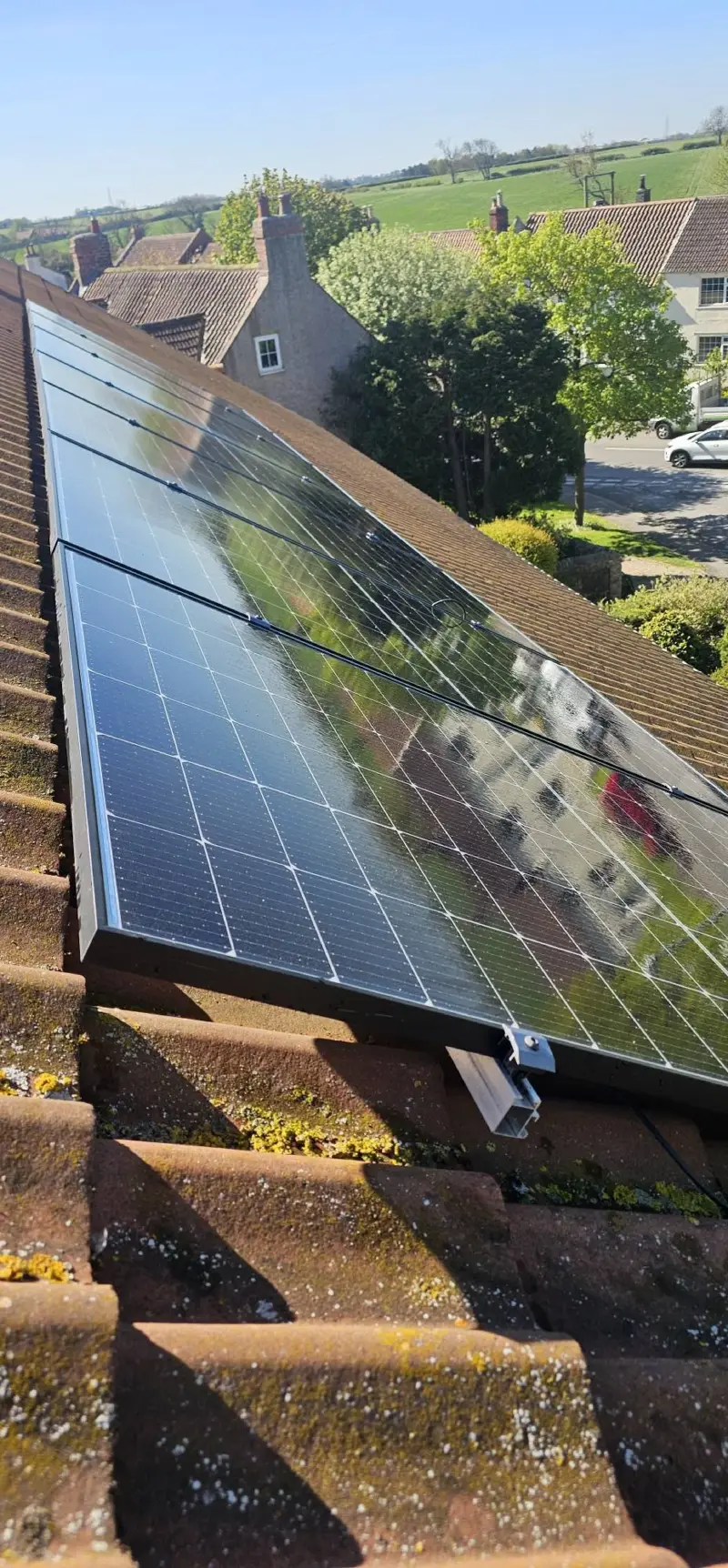
Solar panels are designed to turn daylight into electricity, which means anything that blocks the light is working against you. Dust, pollen, bird droppings and the green film that gathers on panel edges all build up over time. This guide explains what collects on panels, why it matters, how professional solar panel cleaning works, and how often it is worth doing.
What collects on solar panels
Panels sit outdoors all year at an angle, so they collect whatever the weather and the neighbourhood throw at them. The usual culprits are dust and fine road grime, pollen and blossom, bird droppings, leaf debris and the algae and moss that gather along the lower edges of the panels.
Rain helps, but it rarely does a full job. On low-pitched roofs and flat or shallow arrays, water does not run off quickly, so dirt tends to gather in a line along the bottom edge of each panel and dry there. Over time that layer builds up and sticks.
Why clean panels matter
A solar panel works by letting light reach the cells beneath its glass. Anything sitting on that glass absorbs or scatters some of that light before it gets there. A thin, even film of dust is a small effect, but dense patches are more serious. A bird dropping, for example, can shade part of a cell and affect how that section performs.
How much difference cleaning makes varies widely. It depends on how dirty the panels were, how your system is set up and the weather, so we never promise a specific figure. What we can say is that clean glass lets your panels work as they were designed to, and that it is a sensible part of looking after an investment you have already made.
Cleaning also lets you spot problems early. When panels are clean it is much easier to see cracks, damaged frames, loose cabling or nesting birds, so you can have them looked at before they cause bigger problems.
Signs your panels need cleaning
You can usually tell from the ground, and a pair of binoculars helps. Typical signs include:
- A dull, grey or dusty look across the glass compared with when the panels were first installed
- A line of dirt or green growth along the bottom edge of each panel
- Bird droppings, especially in the same spots where birds like to perch
- Moss or algae beginning to creep in from the panel frames
- Leaves, seeds and debris gathered at the edges or in the gaps between panels
- If your system has a monitoring app, output that looks lower than it used to for similar weather
How we clean solar panels
Solar panel glass is delicate, and the wrong approach can scratch it or leave a film behind. We keep it simple, with a water-fed pole, a soft brush and nothing but purified water.
- We agree with you which panels are included and how we will reach them
- A soft brush on a lightweight water-fed pole loosens dirt, droppings and growth from the glass and frames
- Purified water rinses everything away, so the panels dry without spots or residue
- We look over the array as we go and let you know about anything we notice, such as nesting birds, heavy moss or damaged edges
Why we only use pure water
Detergents and cleaning chemicals can leave a film on solar glass, and some can affect seals and frames. Ordinary tap water leaves mineral spots as it dries. Pure water has had its minerals removed, so it rinses clean and dries clear with nothing left behind.
The soft brush does the physical work of loosening dirt, so there is no need for harsh scrubbing. The result is a clean, even surface that lets light through properly, and glass that is not stressed or scratched by the cleaning.
How often should solar panels be cleaned?
There is no universal rule. Many households have their panels cleaned once a year, often in spring after winter grime, or once or twice a year if they are near trees, farmland or busy roads. Panels that birds regularly perch above can need attention more often.
Steeper roofs shed dirt more easily than shallow ones, so panels on a steep pitch may stay cleaner for longer. We are happy to suggest a sensible schedule once we have seen your system.
Panels through the seasons
Spring is the busiest time for pollen and blossom, which sticks to damp glass and dries into a pale, patchy film. Summer brings dust, especially near farmland, building work and dry roads, and sunny weather bakes bird droppings hard onto the surface. Autumn drops leaves, seeds and wet debris against the lower edges of the panels, where they hold moisture and feed algae. Winter is the quietest time for dirt but the hardest for the job, and frost, ice or snow on an array means we would rearrange rather than work on it.
That is why many households choose one main clean a year, in spring or early autumn, and add a second visit if their panels sit under trees or birds regularly perch above them. We are happy to talk through the timing that suits your array.
Can you clean solar panels yourself?
Some people try a hose and a soft brush from the ground, and that can be better than nothing. The challenges are reach, because most arrays are on roofs, and the risk of using the wrong product or too much force on glass.
Getting onto a roof to reach panels is risky, and household detergents can leave films. Many installers also advise checking before using any cleaner. Because we work with pure water and a soft brush from the ground, there is none of that risk to you or your system.
If your panels come with specific care instructions or a warranty, it is sensible to check them before any cleaning. We are happy to talk it through with you.
What to tell us before we quote
A few details help us plan the visit and avoid surprises on the day:
- How many panels you have and where they are, such as one roof slope, two slopes or an extension
- Whether the roof is steep or shallow, and whether the panels are on a flat roof or a ground-mounted frame
- Whether you can see bird nesting, moss or heavy staining around the array
- Any care instructions or warranty conditions from your installer
- Where we can park, and whether there is access to the sides and back of the house
Keeping your panels clean for longer
A few simple steps slow the build-up. Trim branches that drop leaves and blossom onto the array. Keep an eye out for nesting birds, because droppings and nesting material are among the most stubborn things to collect on panels. Keep gutters clear so debris does not wash across the glass.
Solar panel cleaning fits well with other exterior work. Many customers combine it with roof cleaning, so moss around the array is dealt with at the same time, and with gutter cleaning to clear the edge of the roof beneath the panels. Our window cleaning completes the picture so the whole property looks its best.
Solar panel cleaning across Sheffield, Barnsley and Rotherham
South Yorkshire homes with solar panels range from new estates, where arrays are close to open land and tree lines, to older hillside streets where roofs catch a lot of weather. Each sees its own mix of dust, pollen, bird mess and moss.
We clean solar panels across Sheffield (High Green, Chapeltown, Burncross, Ecclesfield, Grenoside, Wincobank, Stannington, Oughtibridge and Hillsborough), Rotherham (Thorpe Hesley, Kimberworth, Greasbrough, Brinsworth, Wickersley, Scholes and North and South Anston) and Barnsley (Tankersley, Hoyland, Birdwell, Elsecar and Wombwell). Choose your town below to see how we handle solar panel cleaning where you live, or send us your address and we will confirm we cover it.
Still reading? There is more.
8 more sections cover: