
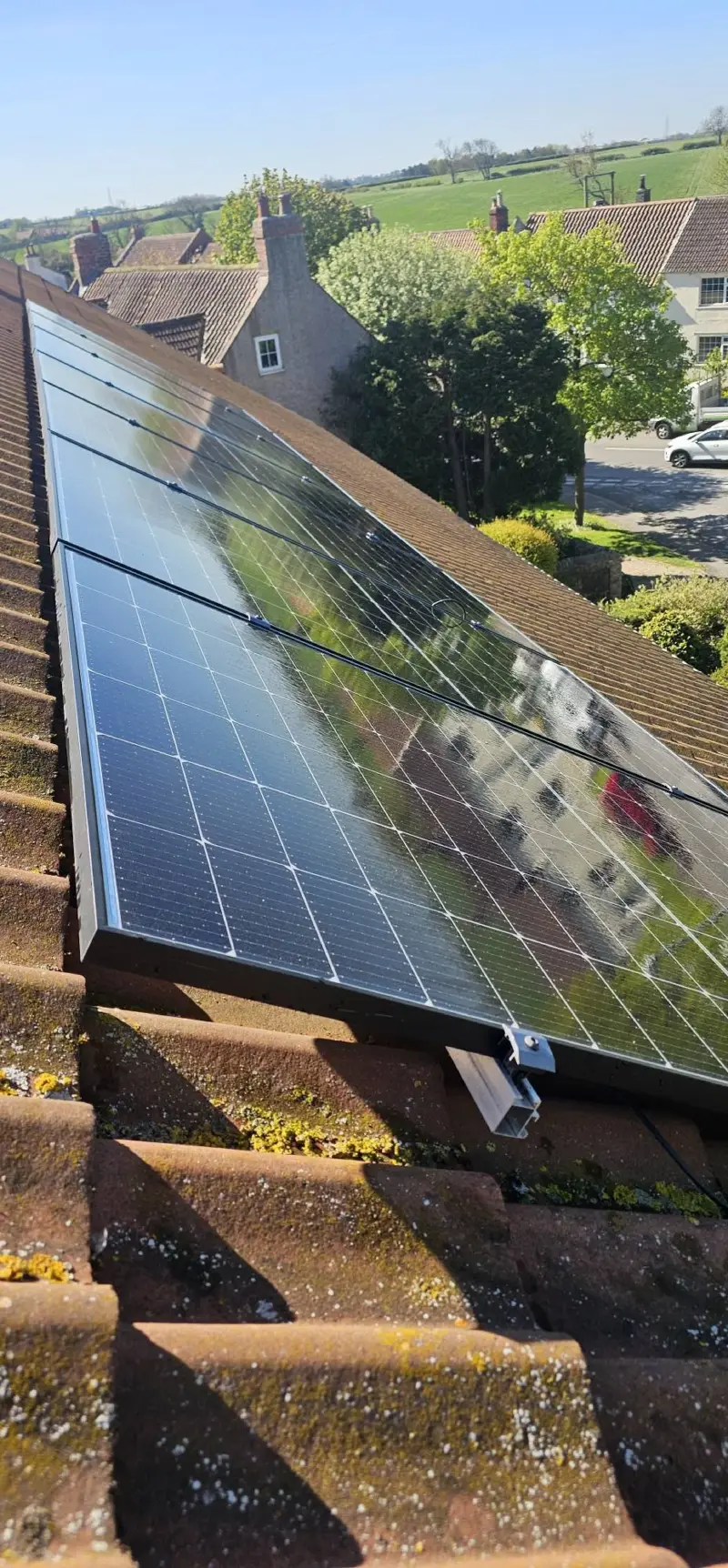
The high, open roofs of Hoyland, Birdwell and Tankersley are well suited to solar, and the ground that gives panels plenty of light also gives them plenty of weather. A south-facing array on an estate slope in Hoyland has little in common with a few panels at the back of a cottage in the Elsecar valley, or with a new-build roof on the edge of Wombwell in the Dearne valley. This guide covers what builds up on arrays in the five places we cover, why a shallow roof makes it worse, how we clean without ever touching the panels, and how to tell when a visit is due.
What builds up on Barnsley panels
Glass tilted towards the sky catches whatever is in the air. In this part of South Yorkshire that includes fine grit and dust blown off roads, fields and the reclaimed sites left behind by the collieries, pollen and blossom in spring, and leaf fall and seed in autumn. Rain removes some of it, but on a shallow roof the water barely moves, and the residue collects along the bottom edge of every panel.
Birds are a fact of life. Chimneys, aerials and the roof ridge are all perches, and droppings dry hard when the sun hits them. In damp spots, moss and algae spread from the frame and the lower edge, and each layer of growth holds a little more dirt and a little more water.
Where Barnsley arrays sit
Installers favour the long, plain roofs of the post-war estates, and Hoyland and Wombwell have plenty of them: concrete-tiled slopes facing open ground, with chimneys and aerials as the only obstacles. Newer homes on the edges of Hoyland, Wombwell and Birdwell often come with panels fitted from new. In older streets and heritage areas such as Elsecar, arrays are rarer, and where they exist they tend to be on rear slopes or outbuildings.
Pitch and aspect change what happens to the dirt. A steep south-facing roof dries fast and sheds well, a shallow or shaded one stays damp. Hillside sites take wind and rain from the south-west, which helps in some ways and carries debris in others. We look at your roof, and what surrounds it, before we say how often cleaning is worthwhile.
Panels in Tankersley and Birdwell
Tankersley and Birdwell sit either side of the junction where the M1 meets the A61 and the Dearne Valley Parkway. Arrays here get wide, open skies, and they also get the fine, greasy dust of a busy road network, which builds into a grey film that rain smears rather than rinses. Homes facing the fields around Tankersley add pollen and dried seed in summer.
Birdwell's estates behind the main road look out over farmland, part of it restored to pasture after surface mining, and over the small woods that survive nearby. Birds work those fields and perch on the ridges above the panels, so droppings are the most common job. A spring clean, with an autumn visit for arrays under trees or perches, suits most roofs in both villages.
Panels in Hoyland
Hoyland stands on a hill spur, with the Lowe Stand folly at the top, and the roofs of its estates face open sky from the Commons to the town centre. Panels here get good light, and also get the full force of the weather. Wind lifts dust and grit from the streets, the fields and the old colliery land, and it drops it on the nearest flat surface.
Bird mess collects along the lines of ridges and chimneys, and the lower rows of panels pick up moss spores from the concrete tiles beneath them. Where trees in gardens overhang the roof, blossom and sap add to the mix. Newer homes at Hoyland North carry arrays on shallow, modern pitches, where the dirty band along the bottom edge builds fastest.
Panels in Elsecar
Elsecar lies in the valley, and the air is damper than up on the hill. Panels are less common here because so much of the village is listed or in a conservation area, but where they have been fitted, such as on later houses or outbuildings, they face the usual valley problems: algae creeping up from the frame, a dull film on the glass and moss at the roof edge.
Trees around Elsecar Park, along the canal and above the reservoir bring leaf litter and sap, and the lower light under the valley sides makes it all the more important to keep the glass clear. If panels sit on or near a listed building, tell us when you enquire. Cleaning from the ground does not touch the roof, but we want to understand the setting.
Panels in Wombwell
Wombwell has a lot of roof space facing the sky, from the post-war estates to the newer developments on the edge of town, and many of the newer houses had panels fitted from new. Low, modern pitches look tidy but shed water slowly, so the tide line along the lower edge of each panel arrives sooner than owners expect.
The Dearne valley keeps the air damp, which encourages algae at the frames, and traffic heading for the shops and leisure at Cortonwood and the main roads adds a fine road dust. Terraced streets near the centre carry fewer arrays, usually on rear slopes, and a photo from the back garden is often enough for us to judge access.
Reading the roof: sun, shade and slope
Panels on the sunniest, steepest part of a roof stay cleanest, because they dry quickly and shed what falls on them. Panels lower down, or on the shaded half of a roof, keep their moisture, and the first sign is usually a green line along the bottom edge. Where one panel looks dirtier than the rest, it is almost always sitting in the shade of something nearby.
We look at those patterns when we visit, since they tell us what is likely to build up again and how soon. A chimney that shades the same panel every afternoon, or a bare branch that droppings arrive from, explains a good deal about why an array gets dirty in the way it does.
How we clean panels in Barnsley
A telescopic pole feeds purified water to a soft-bristled brush, and we work from the ground, across the array in turn. The bristles lift grime, droppings and algae from the glass and frame, and a rinse of pure water carries it off, leaving the panels to dry without spots. Nothing presses hard on the surface and no detergent is used.
Nobody goes on the roof or kneels on a panel, which is the commonest way for arrays to be damaged. Before we start, we agree access and where to stand: a gate to unlock, a dog to keep in, cars or bins to move. If any panel turns out to be beyond a safe reach from below, you will hear about it when we quote.
The Barnsley panel year
March to May is when most owners notice the winter dirt and the pollen, with the brightest months still ahead. Dust and sun-baked droppings are easier to lift before they harden over summer, while autumn leaves and wet debris collect along the lower edge. Ice and frost on a roof are a hazard, so we rebook instead of taking a risk.
For many homes, one visit a year, in spring, is enough. Arrays beneath trees, beside the fields at Tankersley or under a bird perch may want a second in autumn. If you can see your output in an app, a dip on a bright day is a good cue to check the glass.
Panel problems in Barnsley
The same few things turn up from Tankersley to Wombwell:
- A band of dirt, moss or algae along the bottom of each panel
- Bird droppings baked on beneath ridges and chimneys
- Gritty dust from the M1, the A61, fields and old colliery land
- Pollen, blossom and sap from nearby trees
- Green growth creeping out from the frames on damp valley roofs
- Nesting material and debris at the panel edges, which we point out but leave alone
Panels with other jobs in Barnsley
Moss beside the panels is usually moss from the roof itself, which is why roof cleaning in Barnsley is the obvious partner, with gutter cleaning taking care of the channel below. Window cleaning rounds off the visit.
Panels are also cleaned in Sheffield and Rotherham, and everything on offer around Hoyland sits under exterior cleaning in Barnsley.
Still reading? There is more.
8 more sections cover: