
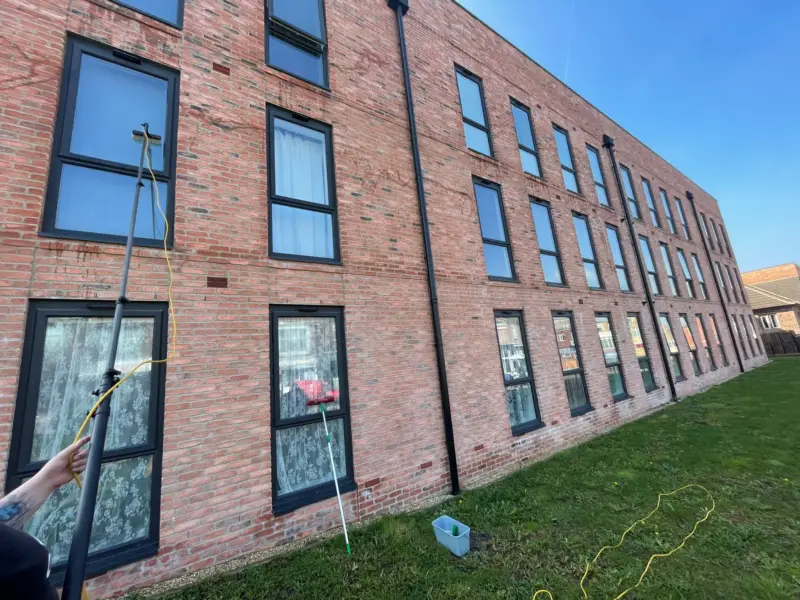
Window cleaning in Sheffield is never one job repeated. In a single day the work can run from a row of estate semis in High Green to a stone cottage on Grenoside's Main Street, then down to a Hillsborough terrace and out along the Don valley to Oughtibridge. The glass is the same, but everything around it changes: the traffic, the trees, the wind, how the house sits on its plot and how close it stands to the street. This guide sets out how we clean windows across the nine places we cover on this side of the city, what each one asks of the job, and what a sensible routine looks like for a Sheffield home.
Why windows get dirty so quickly in Sheffield
Sheffield is built on hills and wrapped in greenery, and both leave a mark on glass. Wind funnels along the valley sides and across the open tops, carrying dust, pollen and grit onto any window that faces it. Rain often arrives at an angle and dries in streaks. The many trees drop blossom, sap and honeydew on whatever sits beneath them.
Roads add their own layer. Penistone Road and Halifax Road carry heavy traffic out of the city to the north-west, Middlewood Road is lined with shops and homes, and the main road through Ecclesfield and Chapeltown is busy all day. Houses close to the kerb collect a fine, greasy film on their glass, and ordinary rain spreads that film rather than rinsing it away.
Slopes matter as well. On a steep street the ground-floor window of one house can sit level with the first-floor window next door, so the dirt on the glass is rarely the same from one front door to the next. Pure water and a soft brush deal with all of it in the same way: they lift the film, rinse it clear and leave nothing behind for the next shower to cling to.
The homes we clean: terraces, estates and village cottages
The housing here is a patchwork. Hillsborough is largely Victorian and Edwardian terraces, built street by street as the city spread up the Don and Loxley valleys. Wincobank has the Flower Estate, an early 20th-century garden suburb of council cottages. The old cores of Ecclesfield, Grenoside, Stannington and Oughtibridge are stone villages whose cottages and chapels pre-date almost everything around them, while High Green, Chapeltown and Burncross are dominated by 20th-century estates and newer builds.
Each type asks something different of window cleaning. Terrace windows sit close to the pavement and are often shaded, so grime builds on the lower panes. Estate semis have wide, even frontages with a mix of original and replacement frames. Village cottages can have small panes, leaded lights or deep stone sills. We look at the property before we start and choose the method to suit it: the pole where it works best, and squeegee and ladder where the glass calls for it.
High Green, Chapeltown and Burncross
These three sit together on the northern edge of the city, and they are where many of our regular rounds begin. High Green is the most northerly suburb of Sheffield, high and open, with long rows of estate houses and a scattering of older stone cottages. Chapeltown, below it, grew around the ironworks at Thorncliffe and now has its own station, park and shops. Burncross runs along the western side of Chapeltown, a mostly residential area of semis, bungalows and detached homes on rising ground.
Windows here are mostly modern frames on 20th-century houses, which makes them quick, tidy work for the pole. What changes is the dirt. High Green glass takes wind-blown dust off the fields and Westwood Country Park, houses on the main road through Chapeltown gather traffic film, and the mature gardens of Burncross drop sap and blossom onto conservatory glass and upstairs panes. A regular round keeps all three in hand before the marks have a chance to bake on.
Ecclesfield and Grenoside
Ecclesfield's historic core, around St Mary's, the church once called the Minster of the Moors, is a place of stone walls and older cottages, with 20th-century housing spreading out on every side. Grenoside sits higher, along a stone-built Main Street on the edge of Greno Woods, and keeps its long-sword dance on Boxing Day. Both villages give us a little of everything: small panes and deep sills in the old cottages, wide modern glass on the newer roads.
The woods are the defining feature for glass in Grenoside. Pollen in spring, honeydew from trees in summer and leaf litter blown against frames in autumn all leave their mark on the houses closest to the trees. In Ecclesfield the traffic matters more, with the main road and the M1 close by. Older stone cottages with small panes are cleaned by hand with a squeegee where that gives a better finish, while the newer houses are quick work for the pole.
Wincobank and the Flower Estate
Wincobank sits on a steep hill above the Don valley, crowned by an Iron Age hill fort and the trees of Wincobank Wood. Below the hill is the Flower Estate, built between the early 1900s and the 1920s as a garden suburb of council cottages, laid out in the spirit of Bournville and Letchworth and named for the flowers on its street signs. Its cottages have modest frontages, gardens in front and a pattern of small and medium windows that a pole handles neatly.
The hill looks down on the Meadowhall area and the Tinsley Viaduct, and homes facing the valley pick up a fine, sooty dust from the roads and the industry below. On the higher streets the wind brings leaves and spores off the wood. Both settle as a dull film rather than obvious dirt, so the difference after a pure water clean is often bigger than customers expect.
Hillsborough, Stannington and Oughtibridge
Hillsborough is terraced streets climbing away from Hillsborough Park and Middlewood Road, with windows set close to the pavement and bay windows on many fronts. Traffic film is the main enemy on the shopping streets and the roads around the stadium, and shade from the houses opposite keeps the lower panes damp. A pole from the pavement reaches the bedroom windows of a terrace without ladders on a narrow, sloping path.
Stannington sits high on the ridge between the Rivelin and Loxley valleys, a village of older stone homes with 1960s estates around it, open to wind and weather. Oughtibridge is the opposite: low in the Don valley between Beeley Wood and Wharncliffe Woods, where damp air encourages green algae in frame corners. Stone cottages in both villages turn up leaded lights and small panes, and where a pole cannot do justice to them, we switch to a squeegee and ladder.
How we work on Sheffield streets
Access in Sheffield is rarely simple, so planning is part of the job. On terraced streets we park considerately and work from the pavement, keeping the pole clear of passers-by and parked cars. On steep roads we check our footing before we set up. On estates with shared drives and side passages, we agree access with you first, and where gates are locked or paths are narrow, we ask in advance.
We bring a lightweight water-fed pole, a soft brush and a tank of purified water, plus a squeegee and ladder for the odd pane the pole cannot do justice to, like a tiny leaded light in an old cottage. The brush loosens dirt from the glass, frame and sill in one pass, and a pure-water rinse carries it away. The windows dry naturally, so nothing is wiped on afterwards and there is nothing to streak. You do not need to be at home for outside cleaning, as long as we can reach the windows.
A year of window cleaning in Sheffield
Autumn brings leaf fall, wet weather and low sun that shows up every smear, so it is a good time to reset the glass before winter. Winter itself is short on daylight and long on frost, and we work only when it is safe, rearranging visits when paths are icy. Spring brings pollen and blossom, which stick to damp glass and dry into a pale film, and the first bright mornings reveal what the winter left. Summer is dust, insects and sun that dries any residue fast, which is why pure water, with nothing in it to dry onto the glass, matters most.
A visit every four to eight weeks suits many Sheffield homes. Houses on Middlewood Road, Halifax Road or the main road through Chapeltown lean towards the shorter end, while a house on a quiet cul-de-sac in Burncross with few trees can go longer. We suggest a routine when we quote and adjust it as we see how quickly your windows get dirty.
Common window problems we see in Sheffield
These are the problems that come up again and again across the nine places we cover here:
- Grey traffic film on glass and frames beside busy roads such as Middlewood Road, Penistone Road and Halifax Road
- Green algae in frame corners and along seals in the Don valley at Oughtibridge and on shaded terraces
- Sap, blossom and honeydew from the trees of Greno Woods, Wincobank Wood and mature gardens
- Mineral spots left by tap water, which pure water avoids
- Dust and fine grit on exposed homes at High Green, Grenoside and Stannington
- Cobwebs and insect marks in deep reveals and above bay windows
Combining window cleaning with other jobs in Sheffield
Many Sheffield customers book windows alongside other exterior work, because one visit saves time and the roofline above drips onto the glass below. Gutter cleaning in Sheffield stops overflow from streaking your clean windows, and soffit and fascia cleaning refreshes the boards above them. If you have a conservatory, conservatory cleaning covers the roof, glass and frames, and shops and offices can ask about commercial window cleaning.
Elsewhere in South Yorkshire, we also offer window cleaning in Rotherham and window cleaning in Barnsley. The whole of exterior cleaning in Sheffield is on one page if you want to see everything we do.
Still reading? There is more.
7 more sections cover: