
The places we cover around Rotherham fall into three landscapes. Thorpe Hesley, Scholes, Kimberworth and Greasbrough climb the hills north-west of the town towards Wentworth. Brinsworth and Wickersley are suburbs either side of it, close to the motorways. North and South Anston sit out on open limestone country near the Nottinghamshire border. Each leaves a different mark on a pane of glass, and a visit that suits one may not suit another. This guide explains how we clean windows in all eight places, what the local housing and roads mean for the work, and how often a Rotherham home can expect a visit.
What lands on Rotherham windows
Motorways run right past several of the places we cover. The M1 passes Thorpe Hesley at junction 35 and runs close to Brinsworth, and the M18 meets it near Wickersley, where Bawtry Road also carries a steady flow of traffic. The exhaust film and road spray they throw up settles on glass facing the carriageway and is spread, not rinsed, by ordinary rain.
Out in the open country around the Anstons, the problem is different. Fields, quarries and wide skies mean pollen in spring, dust in a dry summer and a fine grit that blows in from every direction. On the northern ridges, wind-driven rain strikes the glass at an angle and dries in lines, and the woods around Scholes and Greasbrough add sap and blossom. A window that looks clean in the morning after rain can be streaked by lunchtime, which is why a rinse that leaves nothing behind matters.
Rotherham homes and their windows
Much of the housing here grew with coal and steel. Thorpe Hesley and Kimberworth have older stone and brick homes at their centres with large estates around them, including the post-war Kimberworth Park. Brinsworth is mostly 1930s to 1950s semis and bungalows, and Wickersley has an old village core around St Alban's with big later estates of detached homes. Scholes, Greasbrough and South Anston keep stone cottages from long before the pits, while North Anston is chiefly modern estates. Rear extensions, porches and conservatories are very common across all of them.
That mix means a lot of replacement frames, the occasional older timber window and a great many glazed porches and doors. Estate semis give wide frontages, bungalows put every window at an easy height, and a limestone or sandstone cottage may have tiny panes set in thick walls. Whatever the house, the method follows the glass: the pole for most windows, and a squeegee and ladder for the few that need a hand.
Thorpe Hesley and Scholes
Thorpe Hesley is a former mining village up on the hill by the M1, grown up around Holy Trinity church, with woodland now covering old colliery land around Hesley Wood. Its streets run from older stone and brick terraces at the centre to estates of semis and bungalows on the edges. Glass on the motorway side and along the main road takes a grey traffic film; glass facing the woods takes sap and cobwebs instead.
Scholes is a small stone village where the Wentworth Woodhouse estate meets the farmland to its south, close to Keppel's Column and to Scholes Coppice, an old wood with an Iron Age camp inside it. Cottages here can have small panes, deep stone reveals and older frames, and leaves and pollen from the coppice settle on them through spring and autumn. Those small panes are often done by hand with a squeegee, where that gives a better finish than the pole.
Kimberworth and Greasbrough
Kimberworth stands on a ridge west of the town centre, around Church Street and St Thomas's church, with Kimberworth Road running along it and the big Kimberworth Park estate to the north. Long rows of brick semis and terraces face open views across the Don valley, and the wind up there drives rain onto the glass at an angle. Steep drives and gardens that fall away behind the house make a ladder awkward, which is where the water-fed pole earns its place.
Greasbrough, to the north, grew on land belonging to the Earls Fitzwilliam and sits right beside the parkland and woods of Wentworth Woodhouse. St Mary's church, chapels and older cottages are at its heart, with later homes running down roads such as Munsbrough Rise and Coach Road. Windows near the trees pick up blossom, sap and the dust of autumn leaves, and a regular round keeps them from dulling.
Brinsworth and Wickersley
Brinsworth, south-west of the centre, is mostly estates built from the 1930s to the 1950s, with an older village core near St Andrew's and White Hill as its highest ground. Semis and bungalows with wide, even frontages are quick, tidy work for the pole, and almost every house has a porch, a conservatory or a set of patio doors at the back. Homes nearer the motorway and the main roads collect traffic film faster than those tucked into the estates.
Wickersley, east of the town, is a popular village with the old church of St Alban's, bars and restaurants along the main road, and large estates of detached houses and bungalows around it. Bawtry Road carries heavy traffic, and the M1 and M18 meet just beyond. Big glazed extensions, bi-fold doors and conservatories are common here, so a typical visit has a lot of glass at the back of the house as well as the front.
North Anston and South Anston
Anston is split by Anston Brook, with the A57 and a freight railway running between the two halves. North Anston is largely made up of modern estates, though it keeps an old village green and its village wells. Its open, fairly flat streets suit a pole perfectly, and the work is mostly about the fine dust and pollen that blow in off the surrounding fields.
South Anston is older and more rural, with St James' church, limestone cottages and the quarries whose stone was carted off to rebuild the Houses of Parliament in the 19th century. The dust of stone country is a real feature: a fine, pale film on glass that does not shift with rain alone. Anston Stones Wood, a limestone gorge below the village, adds leaf litter and pollen to the gardens beside it, and small cottage panes are cleaned by hand where needed.
How a window clean runs in Rotherham
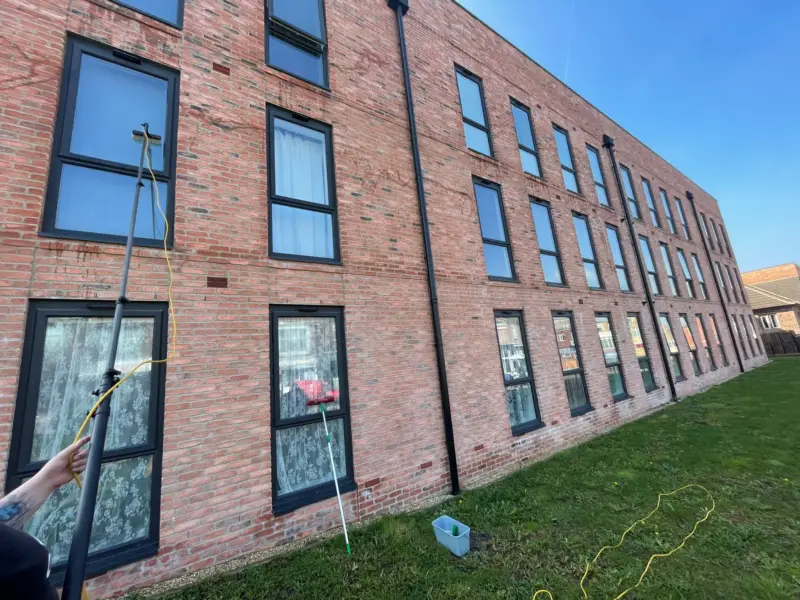
Each visit begins with a quick walk round to see how the property is laid out. Estates and terraces are usually done from the pavement or drive, and homes with side gates need a code or key agreed beforehand. The pole carries a soft brush that works across glass, frame and sill together, and a flush of purified water carries the loosened dirt away.
With the minerals filtered out, the water leaves nothing behind as it dries, so the windows finish clear on their own. A leaded light in an older Scholes or South Anston cottage, or any pane that suits hand work better, is done with a squeegee and ladder. You do not need to be in while we clean the outside.
Porches, extensions and the back of the house
Across Rotherham, the front of a house is only half the story. Bungalows and 1930s semis in Brinsworth have been extended at the back, Wickersley has more than its share of large glazed extensions, and nearly every other house seems to have a porch, a glazed side door or a conservatory. These small panels of glass are easy to forget and quick to show it: a porch window is often the first thing a visitor looks at, and a patio door at the back is the one you look through every day.
We include them in the quote so nothing is left grey. Side gates, narrow passages and gardens with dogs are the usual obstacles, and a quick word beforehand settles every one of them. Where a rear window cannot be reached from the ground, we say so at the quote rather than discover it on the day.
The Rotherham window year
Spring is pollen and blossom, and the fields around the Anstons and the Wentworth parkland send plenty of it. Summer brings dust, especially in dry spells when the quarry country sheds fine powder, and insects on the glass. Autumn is leaf fall and low sun, and the glass looks its worst in the late light. Winter is short days and frost, so visits wait for safe conditions.
A four to eight week cycle works for most homes here. Houses beside the M1 at Thorpe Hesley or on Bawtry Road in Wickersley want the shorter gap, while a quiet close in North Anston with hardly a tree in sight can wait longer. We settle on a rhythm when we quote, then adjust once we see how fast your own windows dirty up.
Window problems we meet in Rotherham
From Thorpe Hesley to South Anston the same few faults come up:
- A grey film from traffic on glass and frames facing the M1, Bawtry Road and the A57
- Pale stone dust on windows near the Anston quarries and in dry weather
- Green growth in frame corners and seals on damp, shaded homes beside the woods
- Sap, blossom and cobwebs on windows near Scholes Coppice, Hesley Wood and the Wentworth estate
- Water spots left by tap water or a hose
- Dirty sills and door panels on porches and conservatories
Window cleaning with other jobs in Rotherham
Plenty of Rotherham customers have the whole outside of the house done at once. Gutter cleaning in Rotherham stops overflow marking clean glass, conservatory cleaning covers the extension at the back, and soffit and fascia cleaning finishes the roofline above. Businesses can look at commercial window cleaning.
Neighbouring areas are covered too: see window cleaning in Sheffield and window cleaning in Barnsley, or browse exterior cleaning in Rotherham for the full list.
Still reading? There is more.
8 more sections cover: