
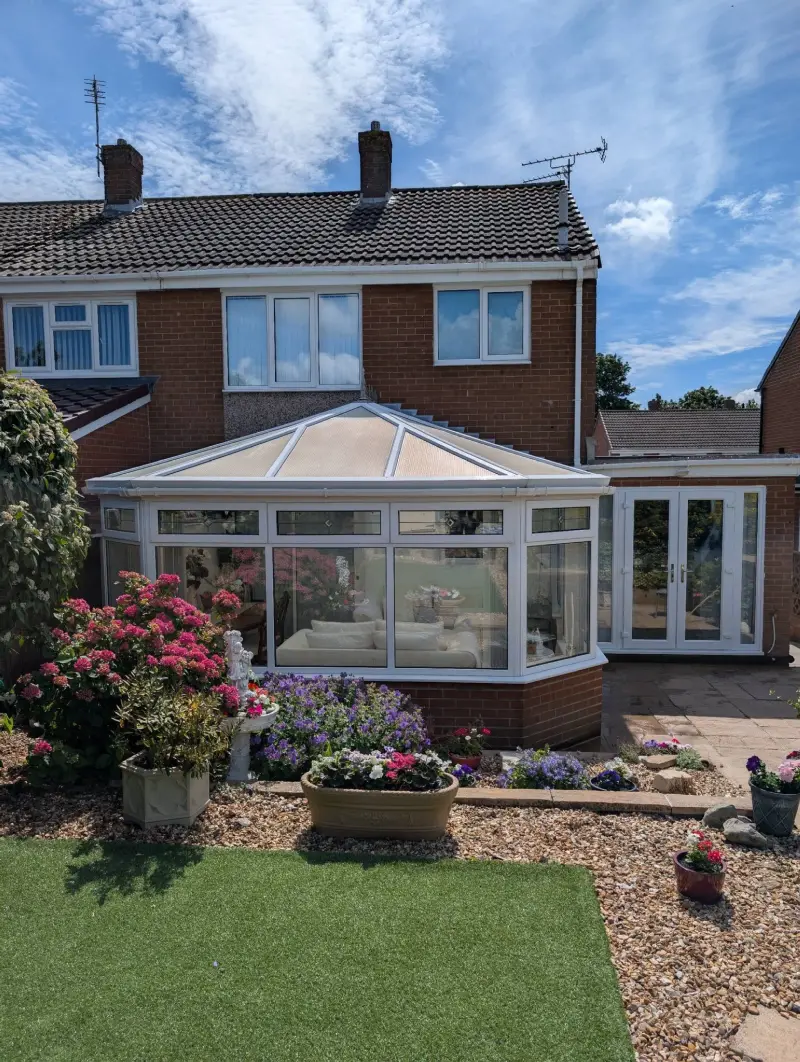
Around Rotherham, an extension at the back is more or less standard equipment on a semi or a bungalow, and a good number of them are conservatories. They are built to be the lightest room in the house, and yet they are the part of a property that the weather works hardest on. A glass or polycarbonate roof has almost no pitch, the frames and seals trap moisture, and the garden around it is full of trees, fences and hedges. This guide sets out what happens to conservatories in Wickersley, Brinsworth, Kimberworth, the Anstons and the villages by Wentworth, how each setting affects the job, and how we clean one without ever putting weight on it.
Why Rotherham conservatories turn green
Rain does not rinse a shallow roof. It sits in the roof bars and along the sides, and it carries pollen, soil and leaf fragments into the joints, where it dries out and starts again after the next shower. Add hours of shade from a fence or a neighbouring gable, and the conditions are ideal for algae, which spreads as a green tint across the panels, and for moss, which fills the gaps.
Birds treat a conservatory roof as a flat, convenient perch, and the droppings bake hard in sunshine. Pale dust from open land and quarries, and sap and blossom from garden trees, stick to it. Most owners only realise how bad the roof has become when they look up from inside on a bright day and see how much light is being blocked.
Styles you find in Rotherham gardens
The common designs are all here. The lean-to is the simple one, a single slope against the back wall. A Victorian or Edwardian style rises to a ridge and is creased with valleys between its facets, and an orangery pairs solid roof sections with a central glass lantern. Gable-fronted conservatories have long roof runs and a tall glazed end. Every one of them has joints and valleys where water, dirt and moss gather.
Roofs are either glass or polycarbonate, and sometimes a mixture. Glass is robust but shows every smear from inside, while polycarbonate is lighter and can scratch under rough cleaning. Some glass carries a self-cleaning coating. We look at the style and the material before we quote, so the plan fits what is actually on the house.
Conservatories in Thorpe Hesley and Scholes
Thorpe Hesley's estates have plenty of semis and bungalows with a conservatory behind the kitchen, and gardens on the woodland side of the village back onto trees that have grown up over the old colliery land. Those roofs collect leaf litter and seed, and stay damp in the shade. On the higher, more open streets, wind-blown dust and grit from the motorway dull the glass instead.
Scholes is a small stone village, and its conservatories are more often a lean-to tucked against an old wall or a garden room on one of the newer houses. With Scholes Coppice and the Wentworth estate so close, roofs here take sap, blossom and a steady fall of leaves, and the stone-coloured frames on some older homes show green growth very clearly.
Conservatories in Kimberworth and Greasbrough
Kimberworth's streets of semis climb the ridge with gardens that fall away behind the house, so a conservatory may sit on a lower terrace with a retaining wall on one side and steps on the other. Ladders are a poor choice there. The pole works from the lawn or the terrace, and a hillside can even lift us closer to the roof line. If the access is truly impossible, we tell you at the quote.
Greasbrough's gardens are ringed with mature planting, with the parkland and woods of Wentworth Woodhouse beyond. Roofs get a heavy dose of sap, seed and leaf litter, and shade keeps them damp for much of the year. A conservatory there often needs its little eaves gutter cleared as much as its roof, and we can do both on the same visit.
Conservatories in Brinsworth and Wickersley
Brinsworth's estates, built from the 1930s to the 1950s, are classic conservatory territory: semis and bungalows with generous back gardens and rear walls ready to take a glazed extension. Most roofs are reachable from a level lawn or patio, and the regular layout of the estates means the work is quick. Homes nearer the motorway and the main roads show a greyer film on the street side.
Wickersley has some of the larger designs we clean, including orangeries and big Edwardian-style conservatories on detached homes and bungalows. Its gardens are mature, with conifers, fruit trees and tall hedges that drop needles and blossom into the roof valleys and keep the panels nearest the boundary in shade. Those valleys are where moss takes hold first.
Conservatories in North Anston and South Anston
North Anston's estates are full of semis and bungalows with rear extensions, and a conservatory is a favourite addition. Gardens tend to be long and open, with fences down both sides, and the land is exposed, so wind carries dust and leaves over the fences onto the roof. The pale limestone dust from the quarries has a particular habit of settling as a haze that rain does not shift.
In South Anston, houses with gardens backing onto the wooded gorge of Anston Stones Wood get leaf litter and sap, and shade on the roof for much of the day. Older limestone homes in the village may have an orangery or a lean-to against a stone wall. A clean in spring and another in autumn is common in both halves of the village.
Fences, hedges and the shade problem
Most Rotherham gardens are bounded by close-boarded fences or tall hedges, and a conservatory tucked into a corner can be in shade from morning until mid-afternoon. A roof that rarely sees the sun stays damp, which is exactly where moss and algae thrive, and the part of the roof closest to the boundary is usually the worst.
Trimming a hedge, lifting the crown of a tree or moving a perch is outside what we do, but it makes a real difference to how long a clean lasts. We are happy to suggest what is likely to be causing the heaviest growth on your roof, and what might be worth changing.
How we clean a conservatory
The method never leaves ground level: a reach pole supplies purified water to a set of soft brushes. They lift moss, algae and droppings from the roof panels and bars, and the side glazing, frames and seals are brushed in the same visit. A rinse of pure water follows each section, and because the minerals have been taken out, it dries clear and leaves no marks on the glass to catch the light.
We start by deciding where to stand: a firm, level place with a clear view of each roof section. We then work round the structure, agree beforehand what is included, and tell you about anything we spot, such as a loose roof cap, a cracked panel, a misting double-glazed unit or seals that have started to lift.
Glass, polycarbonate and special coatings
Both common roof materials suit soft brushes and pure water. Glass benefits from a thorough rinse, since any film is obvious from inside. Polycarbonate needs a gentle touch and no abrasive pads. Neither needs detergent.
Self-cleaning or coated glass should be treated with some care. The coating works with daylight and rain, and it is best left free of harsh cleaners. If your conservatory has one, tell us in your enquiry, together with any guidance from the manufacturer, and we will plan accordingly.
The Rotherham conservatory calendar
Spring coats the roof in pollen and blossom, and the first warm days reveal the winter's algae. Summer bakes bird droppings onto the glass and highlights every mark when the sun is high. Autumn fills roof valleys and gutters with leaves, which hold water through the winter, and winter itself is the time algae grows when nobody is using the room.
Many households book a spring visit to get ready for the summer and an autumn visit after the leaves have gone. Roofs under trees in Greasbrough, Scholes or Wickersley may want more, and a sunny, open conservatory in North Anston can manage with less.
Conservatory problems we meet in Rotherham
A conservatory visit, wherever we are around the town, most often deals with:
- Green algae and moss in the roof bars, in the valleys and along the lower edge
- Bird droppings dried onto the roof beneath fence posts and rooflines
- Grimy frames and tired-looking seals furred with green at the corners
- A mat of leaves and silt clogging the little gutter along the eaves
- Pale dust and sap that dull the glass
- Misted units, which cleaning cannot fix but which show up clearly once the glass is clear
Conservatories with other jobs in Rotherham
Conservatory gutters fill quickly, so gutter cleaning in Rotherham is a natural partner. Roof cleaning looks after the house roof above, and window cleaning covers the glass and frames on the rest of the property.
We also look after conservatories in Sheffield and Barnsley, and you can see the full range under exterior cleaning in Rotherham.
Still reading? There is more.
9 more sections cover:
- Conservatories in Kimberworth and Greasbrough
- Conservatories in Brinsworth and Wickersley
- Conservatories in North Anston and South Anston
- Fences, hedges and the shade problem
- How we clean a conservatory
- Glass, polycarbonate and special coatings
- The Rotherham conservatory calendar
- Conservatory problems we meet in Rotherham
- Conservatories with other jobs in Rotherham