
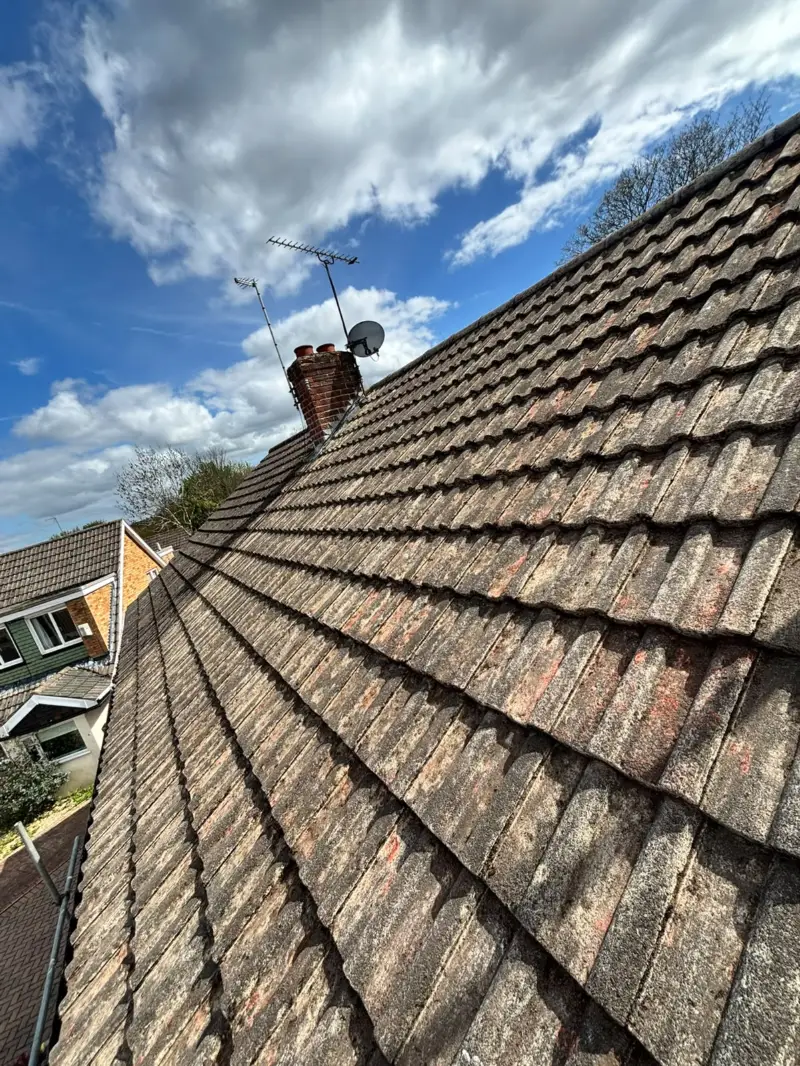
Most people only look at their roof when something goes wrong, but in Rotherham the signs show up from the pavement long before that. Green tiles on a north slope, a dark fringe of moss along the gutter line and grey crust on older tiles all say the same thing: the roof is staying wet. Between the wooded hillsides of Scholes, Greasbrough and Thorpe Hesley, the estates of Kimberworth and Brinsworth, the bungalows of Wickersley and the limestone country around North and South Anston, the reasons differ from street to street. This guide sets out what grows, why, and how we deal with it.
Why Rotherham roofs stay damp
A roof stays clean when it dries quickly, and several things work against that here. Woodland is never far away: the Wentworth Woodhouse estate runs along the northern edge of Greasbrough and Scholes, Hesley Wood sits by Thorpe Hesley, and Anston Stones Wood lies below South Anston. Trees drop leaves, needles and seed onto roofs below, and the debris traps water against the tiles.
Shape and shade matter as well. Many Rotherham homes have been extended, and the low roof of a rear extension or garage sits in the shadow of the main house, which can leave it damp for most of the year. The same goes for a bungalow with high fences and a tall hedge, where sun reaches only part of the roof. Moss, lichen and dark algae appear first in these places and spread outwards.
Rotherham roofs by type
The borough's building history is written on its roofs. Older terraces in the centres of Thorpe Hesley, Kimberworth and Greasbrough are often slated. The long estates of the 1930s to the 1950s, in Brinsworth and around Kimberworth Park, are mostly tiled, in plain pitches that run the length of a street. Newer developments in Wickersley and North Anston use concrete tiles, usually on shallow pitches, and almost every place has bungalows and extensions with low, flat-looking roofs.
In the older villages, Scholes and South Anston above all, stone cottages and farmhouses may carry clay pantiles or stone slate. Those roofs are valued and sometimes fragile, so we assess each one before agreeing to scrape it. If a roof is better left alone or needs a specialist, we say so at the quote, and we do not push a job that could harm the tiles.
Roofs in Thorpe Hesley and Scholes
Thorpe Hesley is a hilltop village beside the M1, where the terraces and cottages of its mining past sit among later estates. Its higher streets take the wind, which dries some slopes and drives rain into others, while homes on the woodland side, where trees have grown over the old colliery tips, live with shade and leaf fall. North-facing tiles and the lower courses of each slope are where the moss settles first.
Scholes is smaller and older, a stone village on the edge of the Wentworth estate with Scholes Coppice beside it. Roofs here may be stone slate or old clay tile, set among trees that drip and shade them for much of the year. They are exactly the kind of roof we look at closely before agreeing anything, because careful hand work suits them and heavy-handed work does not.
Roofs in Kimberworth and Greasbrough
Kimberworth rises above the town on a ridge, with homes along Kimberworth Road, the older streets around St Thomas's church and the long tiled rows of Kimberworth Park. Roofs face every direction up here, and the north and east slopes, with the valley wind behind them, are reliably the greenest. Because so many houses on the estate share a design, a pattern of moss on one roof is often repeated all along the street.
Greasbrough, with its church, chapels and old estate land, has gardens and woodland on all sides and the parkland of Wentworth Woodhouse at its back. A branch hanging over a roof drips sap, drops seed and shades the slope, while leaf litter piles up in valleys and behind chimneys. These roofs rarely dry, so moss comes back quickly after a clean unless the branches are cut back as well.
Roofs in Brinsworth and Wickersley
Brinsworth's estates, built from the 1930s to the 1950s, carry hipped and gabled tiled roofs in regular rows, with bungalows dotted among them. The roofs are plain and easy to read, and the trouble spots are predictable: the shaded side of the hip, the junction with a rear extension and the flat-looking roof of a garage. White Hill, the highest ground, catches more weather than the streets below it.
Wickersley is bungalow country as much as anywhere in the borough, with large estates of detached homes and generous, mature gardens. Tall hedges, conifers and fruit trees keep low roofs shaded, and big extensions add another roof below the main one. We often find the main house fairly clean and the extension roof thick with moss, which is why we agree every roof on the property before we start.
Roofs in North Anston and South Anston
North Anston's suburban estates have concrete tile roofs on fairly open, level ground, where the wind across the fields dries them faster than a valley roof would. Moss still gathers on the shaded slope and along the bottom courses, and the dust carried in from the surrounding farmland and quarries settles into it and darkens it.
South Anston, across the brook and the A57, is the older village, with limestone houses and cottages of real age and gardens running down towards Anston Stones Wood. Some roofs there are clay pantiles or stone slate and need a careful look first. Leaves and seed from the gorge end up in roof valleys, and the damp that stays in them feeds moss right at the tile edge.
Chimneys, ridges and valleys
Even a roof that looks sound from the road hides trouble spots. The base of a chimney stack channels water towards the tiles beside it, the ridge line collects dust and spores along its mortar, and the valley where two slopes meet carries the runoff of both. These are the places where growth is thickest and where it dries last.
They are also where a hand-held scraper is better than anything mechanical: it reaches into the angles and the junctions, and we can see exactly what is under the moss. On a Rotherham estate, where a row of identical roofs all have the same weak points, it is common to find the same pattern on every house in the street.
How we treat a roof in Rotherham
Every job begins with a look at the roof and a conversation about what is included: the main slopes, any extensions and porches, and whether you would like the gutters cleared at the same time. Moss and lichen are then removed by hand, working steadily across each slope, and the debris is gathered up and taken away from the roof, the gutters and the garden.
Once the roof is clear, a biocide is applied over the surface. It deals with the spores and the thin growth the scraper cannot lift, and over the weeks that follow the remaining growth dies back and rain washes it off. We keep the mess contained as we go, cover vulnerable plants and parked cars, and report anything we spot, such as slipped, cracked or porous tiles.
The Rotherham roof calendar
Moss grows fastest in the cool, damp months, and slows when the weather dries in late spring and summer. That makes April to July the best window for most roofs: the surface is dry enough to work on, and the biocide then has settled weather to begin its work. Autumn is the next best, particularly for roofs under trees in Greasbrough and Scholes, once the main leaf fall is over.
Winter work depends on frost and wind, and on the high ground at Thorpe Hesley and Kimberworth we often wait for a calmer day. Whatever the season, check the roof from the ground once a year. Dark patches, green edges or moss in the gutter tell you it is time to book.
Roof problems we meet in Rotherham
These are the faults that turn up again and again, from the Wentworth side of the borough to the Anstons:
- Moss spreading along the lower courses of bungalow and extension roofs shaded by fences and hedges
- Dark algae streaks below the ridge on long, plain estate roofs
- Lichen forming crusty patches on older tiles and on stone slate
- Leaf litter and seed packed into valleys beside woodland and mature gardens
- Moss breaking loose into gutters and blocking downpipes
- Cracked or slipped tiles that become visible once the cover of growth is gone
Roof cleaning with other jobs in Rotherham
Roof moss lands in the gutters, which is why many customers book gutter cleaning in Rotherham at the same visit. Soffit and fascia cleaning then freshens the boards at the roof edge, and conservatory cleaning covers the glazed roof at the back. If you have panels on the slope, solar panel cleaning clears them as well.
The same roof service is available in Sheffield and Barnsley, or see everything on offer locally under exterior cleaning in Rotherham.
Still reading? There is more.
8 more sections cover: